Trinidad: The Mother of Caribbean Carnival
Every carnival in the Caribbean has its own story, but one island wrote the grammar the others speak. Trinidad did not invent masquerade – Africa and Europe both brought masking traditions across the Atlantic – yet it was in Trinidad that these traditions collided, fused and produced the festival form that now travels the world: mas bands on the road, calypso and soca as the soundtrack, steelpan as the invented instrument and J'ouvert opening the celebration before dawn.
7/19/202610 min read
A festival forged twice
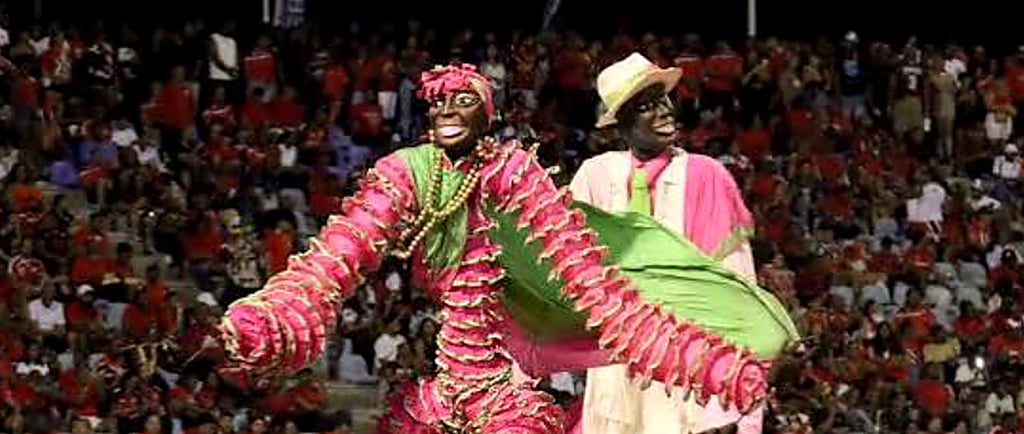
Carnival arrived in Trinidad with the Cedula of Population in 1783, when Spanish Trinidad opened its doors to Catholic settlers. French planters from Martinique, Guadeloupe and Grenada brought their pre-Lenten season of masked balls and fêtes, and within a few years the island had an elite carnival of ballrooms, house visits and costumed drives. Enslaved Africans were excluded by law, though they watched, remembered and kept their own traditions of drumming, stick-fighting and satirical performance alive – including the Dame Lorraine masque, held in their own yards, which parodied the manners of the planters' ballrooms.
The elite carnival held a disturbing secret at its heart: the planters loved to disguise themselves as the people they enslaved. Behind their masks, white men blackened their faces with soot to play the negre jardin – the field labourer – while white women dressed as the mulatresse. They even staged mock Canboulay processions, imitating enslaved people being driven with torches and whips to put out cane fires, performed as a burlesque for their own amusement. The Trinidad Sentinel reported as late as 1860 that princes and lords of the land paraded in the sooty disguise of the negre jardin, with even the residents of Government House joining in. Concealment was the point – the mask allowed the ruling class to play at being the people they owned, stripped of all danger and all meaning.
The festival was forged a second time at emancipation. The Abolition Act took effect on the first of August 1834, and full freedom came on the first of August 1838 when the apprenticeship system ended. In the years that followed, the formerly enslaved population performed Canboulay – from cannes brûlées, burnt canes – on the first of August itself, as a torchlit commemoration of freedom that transformed the memory of being driven to burning cane fields into ritual theatre performed by free people on their own roads. Around the 1840s the procession migrated from Emancipation Day into the pre-Lenten season, where it claimed the carnival and opened it in the dark hours before dawn. Where the planters had staged Canboulay as a joke, freed people restored it as testimony. Canboulay brought drums, chantwells, stick-fighting bands and masquerade characters into carnival, and the negre jardin itself was reclaimed – the stick fighters adopted the aristocrats' favourite disguise as the costume for kalenda, so that a character invented as an enslaver's fantasy became, in free hands, an act of mockery and inversion. The white and coloured elite withdrew from the streets in disgust, and the press of the mid-1800s filled with complaints about the so-called jamette carnival of the urban poor – the drums, the fighting, the frankness, the satire aimed upward at respectable society. Yet the withdrawal was never as complete as respectability claimed. Accounts describe white and middle-class men slipping into the masked bands incognito, indulging behind masks in the very carnival their newspapers condemned – the jamette women were recorded openly soliciting men of the middle class, which tells its own story about who was in the crowd. Masks hid class as well as identity, and this was part of why Governor Keate banned them in 1858: an anonymous crowd was not only ungovernable but socially porous, letting respectable men cross into the jamette carnival and back without consequence. Masqueraders answered the ban with characteristic wit, carrying their masks on sticks – the origin of the standard that completes a mas costume to this day – or covering their faces with soot and paint instead.
The colonial authorities tried repeatedly to crush the festival, and in the Canboulay Riots of 1881 the people of Port of Spain fought Captain Baker's police and held the streets. The authorities answered not with force but with law: the ordinance of 1884 banned the torch processions and the skin drums, tightening the restrictions on masking that had begun with Keate's ban of 1858. The drummers turned to bamboo percussion – tamboo bamboo – and eventually, in the panyards of Port of Spain in the late 1930s and 1940s, to the steelpan, often described as the only acoustic instrument invented in the twentieth century.
This is why historians call Trinidad the mother of Caribbean carnival. The French gave the island a carnival season, but freed Africans gave it its soul, and Trinidad went on to develop the complete form – organised mas bands with themed presentations, calypso tents and competitions, Panorama, Dimanche Gras and J'ouvert – that other islands and the diaspora would later adopt and adapt.
J'ouvert and the politics of disguise
Canboulay's spirit survived suppression in J'ouvert – from the French Creole jou ouvè, day opens – the pre-dawn opening of carnival that remains its most sacred hour. J'ouvert kept everything the authorities had tried to remove: darkness, drums, mud, old clothes, satire and bodies pressed together on the road. Players cover themselves in mud, oil, paint, soot or molasses, and the coverings work on three levels at once.
The first is disguise – and concealment worked in every direction. For the servants, dockworkers and labourers who played Canboulay and early J'ouvert, being covered in mud or molasses and playing in darkness meant they could mock the magistrate and act out the forbidden without being recognised and punished by employers, police and the respectable classes watching from their windows. For the respectable men who slipped covertly into the jamette carnival, the mask hid their class and protected their reputations. The authorities understood all of this – an unrecognisable crowd is an ungovernable one, and a socially porous one – which is precisely why they banned the masks. The jab molassie, the molasses devil, embodies the tradition at its most defiant: blackened with molasses or tar, horned and chained, at once a disguise and a fearsome image of the plantation's cruelty turned back on the society that profited from it.
The second is levelling. A crowd uniformly covered in mud has no visible hierarchy of colour, class or costume – everyone looks the same, and everyone is equal on the road.
The third is meaning. The mud, oil and soot carry the memory of estate labour, the cane fires and the devils of the plantation imagination – and they carry the great inversion at the heart of the festival. Where white planters had once blackened their faces to play the enslaved for a joke, freed people covered themselves to remember, to resist and to be free. The same imagery, twice used, with opposite intent. Today's J'ouvert players who choose mud over feathers are keeping that inheritance alive – a deliberate refusal of prettiness in favour of history.
The truck and the road
Class never left carnival; it changed vehicles. When the respectable classes returned to the festival around the turn of the twentieth century – lured back by the tamed, organised, competition-driven carnival the merchants had built – many returned on decorated lorries and floats, elevated above the crowd and physically separated from the Black working-class masqueraders on the road. Being on the truck meant being in carnival without being of it: no rubbing shoulders, no chipping in the crowd, the social distance of the ballroom reproduced on wheels.
The modern echo is unmistakable in the criticism of today's all-inclusive pretty mas bands, with their ropes, security lines and costume prices that keep ordinary people at a distance from a festival their ancestors created and defended. The truck never entirely disappeared; it acquired wristbands. And it is against this backdrop that J'ouvert's meaning sharpens – while the daytime parade grew ever more commercial and stratified, the pre-dawn mas remained the people's carnival, the space where the emancipation inheritance is most intact. Many would say J'ouvert, not the bikini parade, is the true heart of the festival.
Sisters, cousins and daughters
Not every Caribbean carnival descends from Trinidad in a straight line. The French Catholic islands – Martinique, Guadeloupe, Haiti, Dominica, St Lucia and Carriacou – inherited the same pre-Lenten season and went through their own emancipation transformations in parallel. These are Trinidad's sisters and cousins rather than her daughters. Other festivals grew from different roots entirely: Barbados's Crop Over from the plantation harvest, Antigua's carnival from the commemoration of emancipation itself, and Jonkonnu in Jamaica and the Bahamas from a Christmas masquerade tradition with its own African lineage.
What unites them today is the Trinidad model. When Barbados revived Crop Over in 1974, when St Vincent created Vincy Mas in 1977, when Grenada moved Spicemas to August in 1981 and when St Lucia shifted her carnival to July in 1999, each reached for the Trinidadian toolkit of soca monarchs, costumed bands and road marches. And when Trinidadians and their Caribbean neighbours settled in London, New York and Toronto, they carried the form with them – which is why Notting Hill, Brooklyn and Caribana all speak with a Trinidadian accent, whatever flags fly on the road.
The inheritance
To call Trinidad the mother carnival is not to diminish her sisters. St Lucia, Martinique and Dominica kept their own creole traditions alive through the same struggles; Barbados and Antigua built festivals from their own histories of harvest and freedom. But the road march, the mas band, the pan yard and the pre-dawn J'ouvert all carry a Trinidadian birthmark, and wherever Caribbean people have settled, that inheritance has taken root. Sixty years after Russ Henderson lifted his pan and led the procession through the streets of Notting Hill, the daughter carnivals now number in the hundreds across Europe and North America – every one of them tracing a line back through emancipation, through Canboulay, to the island where a people took the enslavers' masquerade, turned it inside out and made survival into celebration. Whoever plays J'ouvert this year, anywhere in the world, covered in mud before the sun comes up, is finishing a sentence that freed people began on the roads of Port of Spain in 1838.
Questions and answers
Which island invented Caribbean carnival? Trinidad is credited as the mother of Caribbean carnival, though the honest answer is that it was created twice: French planters brought the pre-Lenten season in 1783, and freed Africans remade it as a street festival after emancipation in 1838. Martinique and Guadeloupe have carnivals at least as old, since the settlers came from there, but Trinidad developed the complete form – mas bands, calypso, steelpan and J'ouvert – that the rest of the region and the diaspora adopted.
When was the first Trinidad Carnival? No single first carnival was recorded. The season took root within a few years of the Cedula of Population in 1783, and the earliest detailed written accounts come from the early 1800s. The street festival belonging to the whole population dates from emancipation.
Why was Canboulay held on the first of August? Because the first of August was Emancipation Day – the Abolition Act took effect on that date in 1834, and full freedom came on the same date in 1838. Canboulay began as a torchlit commemoration of freedom held on the anniversary itself, and migrated into the pre-Lenten carnival season around the 1840s.
Did Tobago have a carnival? No – Tobago was a separate colony until 1889, British and Protestant rather than French and Catholic, so it never developed the pre-Lenten tradition. Its heritage runs through speech bands, the Tobago jig and harvest festivals, celebrated since 1987 in the Tobago Heritage Festival each July. Tobagonians play mas today, but carnival was a Trinidad creation that Tobago joined.
What is J'ouvert and where does the name come from? J'ouvert comes from the French Creole jou ouvè – day opens. It is the pre-dawn opening of carnival and the direct descendant of Canboulay, keeping the darkness, drums, mud, satire and freedom that the colonial authorities spent decades trying to suppress.
Why do J'ouvert players cover themselves in mud and oil? For three reasons at once. Disguise – in the nineteenth century a covered masquerader could mock the powerful without being recognised and punished. Levelling – a crowd uniformly covered in mud has no visible hierarchy of colour, class or costume. Meaning – the mud, soot and molasses carry the memory of estate labour, the cane fires and the devils of the plantation imagination.
Is J'ouvert truly Trinidadian? The word is shared; the institution is Trinidadian. Jou ouvè is French Creole, spoken across St Lucia, Dominica, Martinique and Guadeloupe, and daybreak celebrations exist throughout the French Antillean world – Martinique and Guadeloupe have the vidé, their own early-morning street rush. But J'ouvert as the world knows it – the pre-dawn mas with Canboulay in its bloodline, the mud, oil and molasses, the devils and the ole mas satire – was forged in Trinidad through the struggles of the nineteenth century, and it is the Trinidad form that Grenada, St Lucia, Antigua and Brooklyn follow today.
Is Jab Jab Grenadian or Trinidadian? Both, confusingly, because the name points to two different characters. Grenada's Jab Jab is the famous oil devil – blackened head to toe, horned and chained – and it is fiercely Grenadian: not a copy of Trinidad but a sibling grown from Grenada's own emancipation history, kept so alive that Grenadians call themselves the Jab Jab nation. Trinidad's equivalent oil devil is the jab molassie, the molasses devil, while Trinidad's own character called Jab Jab is different again – a whip-cracking devil in bright satin. All descend from the French diable, devil, through the shared creole inheritance. In Trinidad the oil devil dwindled as pretty mas rose; in Grenada it reigned, and today the Grenadian name leads the whole family.
Is it true that white people disguised themselves at carnival? Yes, in two distinct eras. Before emancipation, planters masked and blackened their faces to play the negre jardin and the mulatresse, even staging mock Canboulay processions as a burlesque. After emancipation, when the elite had officially withdrawn from the streets, accounts describe white and middle-class men slipping into the masked bands incognito – one reason Governor Keate banned masks in 1858. Concealment was always part of carnival; the question was who used it and why.
Was being on the truck really about class? Largely, yes. When the respectable classes returned to street carnival around the turn of the twentieth century, many did so on decorated lorries, elevated above and separated from the Black working-class masqueraders on the road. The criticism of today's roped-off all-inclusive bands is the modern chapter of the same story.
Why are so many island carnivals held in summer rather than before Lent? Some were never pre-Lenten at all – Antigua's carnival commemorates emancipation in August, Crop Over follows the sugar harvest and Sugar Mas belongs to Christmas. Others deliberately moved: St Vincent in 1977, Grenada in 1981 and St Lucia in 1999 all shifted their old pre-Lenten festivals to summer, partly to step out of Trinidad's shadow and catch the tourist and diaspora season.
How did carnival reach Notting Hill? Caribbean settlers carried it with them, and it arrived in stages. Claudia Jones staged an indoor Caribbean carnival in London in 1959 in the aftermath of the Notting Hill attacks, and in 1966, at Rhaune Laslett's street fair, Russ Henderson lifted his pan and led his steelband on an impromptu procession through the streets, with the crowd falling in behind – the founding act of the street carnival. In 1970 Laslett cancelled the event and withdrew, and the Caribbean community – mostly Trinidadians – took the carnival over and made it their own, with Leslie Palmer's directorship from 1973 transforming it into a mass festival of mas bands, steelbands and sound systems. It grew into the largest street festival in Europe, its traditions descending directly from Trinidad and joined over the decades by the sounds and flags of the whole Caribbean – a daughter carnival that became a matriarch in her own right, marking her sixtieth anniversary in 2026.
The Caribbean Carnivals
Contact
QUESTIONS? REACH OUT ANYTIME
hello@nottinghillwalks.co.uk
© 2026. All rights reserved.
Partners

Notting Hill Walks is part of More Curricular alongside Hidden Tudors Tours