Notting Hill's Missing Church: Why the Area Had None for Centuries
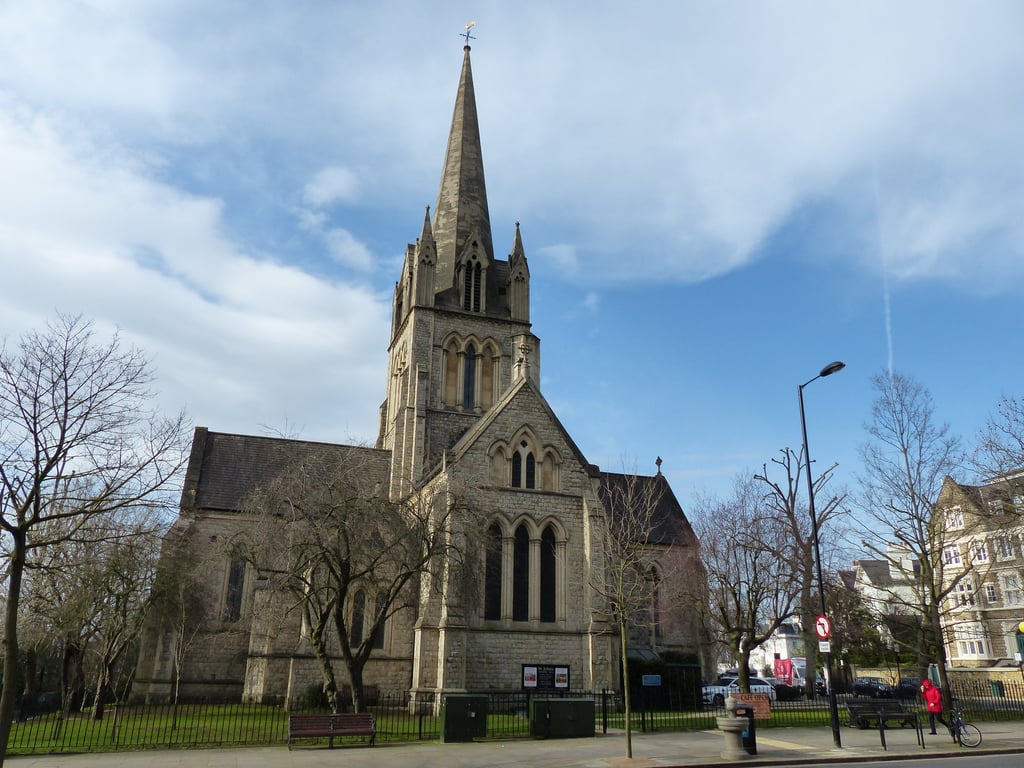
Walk down Talbot Road today and All Saints Church looks as though it has always belonged there, its polychromatic Gothic tower rising above the terraces of Notting Hill. Walk along Lansdowne Crescent and St John's does the same. It is easy to assume that a place with this much visible history has always had a church of its own. It has not.
7/24/20264 min read
A name older than the place
The name itself is far older than any settlement it describes. "Notting Hill" first appears in the Patent Rolls of 1356 as Knottynghull, more than a century before the Tudor period began, and again in 1550, as Notynghyll, well within it.
Its origin is uncertain. The most widely accepted theory ties "Nott" to the Saxon personal name Cnotta, with "ing" denoting a group or settlement of people, so the name would originally have meant something close to the hill of Cnotta's people. An older idea linking it to King Canute has fallen out of favour. A separate account, published in 1878, instead traces the name to a manor called Knotting-Bernes, Knutting-Barnes or Nutting-barns, citing a Henry VIII-era court record referring to "the manor called Notingbarons, alias Kensington" – the very manor of Notting Barns that Sir Walter Cope bought in 1599.
Whichever explanation is correct, for close to five hundred years the name belonged to a hill and a manor, not to a village. It is worth holding on to that distinction: this was a very old name attached to a very long-empty stretch of land.
No Notting Hill, no Notting Hill church
During the Tudor period, Notting Hill did not exist as a place at all. There was no village, no parish and certainly no church. The high ground west of London that would eventually take that name was simply farmland, part of the manor of Abbots Kensington. Its northern portion, later known as Notting Barns, was bought by the courtier and property speculator Sir Walter Cope in 1599, alongside the manor of West Town, which he had acquired in 1591. Both manors lay within the wider parish of Kensington, and neither had, nor needed, a church.
Where everyone actually went
Anyone living or working on this land during the reigns of the Tudor monarchs belonged to a single parish, centred on a single church: St Mary Abbots, a couple of miles south in Kensington village. It was, in fact, the only church in the whole of Kensington until the nineteenth century.
The church's own history stretches back further still. Around 1100, Aubrey de Vere, lord of the manor of Kensington after the Norman Conquest, saw his son Godfrey fall gravely ill. Godfrey was cared for by Faritius, Abbot of the Benedictine Abbey at Abingdon, and on his death bequeathed the Kensington church and 270 acres of land to that abbey in gratitude. The parish was formally established around 1260, taking the name Abbots from this Abingdon connection. Patronage of the church later passed to the Bishop of London after a dispute in the diocesan consistory court.
The building that stood through the whole of the Tudor period was a rebuild dating from 1370, in the reign of Edward III. It was a modest structure: stone-built, with a low tower and a small spire that barely rose above the roofline of the nave. This is what greeted every tenant, farmhand and labourer from the land now called Notting Hill each Sunday, after a walk of two miles or more along the highway to Uxbridge.
When Notting Hill finally got its own churches
That situation held for centuries. St Mary Abbots was rebuilt again at the end of the seventeenth century, once the arrival of the royal court at Kensington Palace in 1689 made the old medieval church too small, and again in the 1870s to designs by Sir George Gilbert Scott, the building that still stands today, with the tallest spire in London.
Notting Hill itself had to wait until the Victorian era for a church of its own. As the Ladbroke estate was laid out for housing from the 1840s, four churches went up in quick succession:
St John's, completed in 1845, the centrepiece of the Ladbroke estate
St Peter's, consecrated in 1857
All Saints, begun in 1852 and structurally complete by 1855, but left without glass or furniture after its backer, Samuel Walker, went bankrupt, before being finished and consecrated in 1861
St Francis of Assisi, built in 1859 to 1860 for the Catholic parish
Every one of them is a nineteenth-century building. None carries so much as an echo of the Tudor period, because there was nothing there to echo. The real Tudor-era link to this stretch of London runs south, to the small stone church at Kensington that quietly outlasted every generation of farmers who once walked to it across what is now Notting Hill.
Frequently asked questions
Was there ever a church actually on Notting Hill during the Tudor period? No. No church, village or parish existed on the ground now called Notting Hill until the nineteenth century. Anyone living there worshipped two miles south, at St Mary Abbots in Kensington village.
Can I still see anything from that period today? St Mary Abbots itself has been rebuilt twice since, so the present building dates from the 1870s. But the parish boundary, the old highway to Uxbridge and the route people once walked to church can still be traced on the ground – it is exactly this kind of layered, easy-to-miss history that I bring to life on my walking tours around Notting Hill.
Where can I hear this history in person, rather than just reading it? On one of my Notting Hill walks, where stories like this one are told standing on the actual site, alongside the area's Tudor, Victorian and Carnival-era history. Book at nottinghillcarnival60.co.uk/#walks.
What is Carnival 60? Carnival 60 is a six-month heritage programme marking sixty years of Notting Hill Carnival, running at Mason & Fifth through October 2026. It includes panels, suppers, pub events, walks and an In Conversation series exploring the Carnival's history and the community that built it, with a major cluster of events in August. Full details and the programme are at nottinghillcarnival60.co.uk.
How does a missing Tudor church connect to Carnival? Both come down to the same idea: what Notting Hill looks like today, whether that is a Victorian church or a Carnival now marking six decades, sits on top of a much older and quieter history. Carnival 60 traces that fuller story across a season of events, from panels on the Mangrove Nine to walks through the streets where it all took place – so if this piece caught your interest, that programme is where to go next.
Contact
QUESTIONS? REACH OUT ANYTIME
hello@nottinghillwalks.co.uk
© 2026. All rights reserved.
Partners

Notting Hill Walks is part of More Curricular alongside Hidden Tudors Tours