Notting Hill Carnival 60: Six Months of Heritage Events 2026
Notting Hill Carnival turns 60 in 2026. Join walks, talks and Caribbean suppers celebrating the real history. Notting Hill Carnival 60 programme launches April 2026.
1/7/20265 min read
Why Notting Hill Carnival 60 Matters
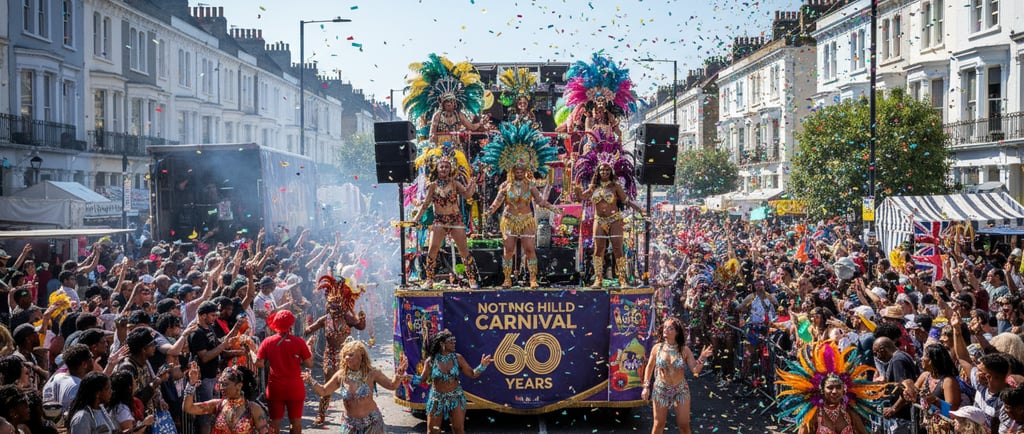
Notting Hill Carnival began in 1966—historians debate whether 1965 or 1966—when Rhaune Laslett, a community activist who actually lived in Notting Hill, organized a multicultural street celebration. Laslett imagined a festival bringing together the neighbourhood's diverse residents: people from Ukraine, Spain, Portugal, Ireland, the Caribbean, and Africa all living side by side in what was then a working-class area.
Crucially, Notting Hill Carnival didn't begin as a specifically Caribbean event. Musician Russ Henderson introduced that element. Henderson had performed at Claudia Jones's indoor Caribbean carnivals at St Pancras Town Hall (1959-1964), and when he took his steel band out into Laslett's street festival, marching through the roads with people following the music, the Caribbean character started taking shape. That first year, roughly 1,000 people attended.
But the Notting Hill Carnival we know today—Europe's largest street festival—was built by Leslie Palmer. Born in Tunapuna, Trinidad in 1943, Palmer arrived in England in 1964 aged just 21. When he became carnival director in 1973, the event remained relatively small. Within two years, he'd transformed it into a phenomenon, exploding attendance from roughly 3,000 participants to 50,000.
Palmer's innovations reshaped everything: merging steelbands, reggae, and sound systems into one celebration; bringing proper masquerade bands with elaborate traditional costumes onto London streets; introducing electric generators that made static sound systems possible; extending the carnival route right across West London. Most significantly, he transformed what had been primarily one island's tradition into a genuinely pan-Caribbean movement, building a space where every Caribbean island, every generation, and every musical style found a home.
This history matters because Notting Hill Carnival emerged during a period of intense racism and hostility. The 1958 race riots had made Notting Hill synonymous with racial violence. "No Irish, No Blacks, No Dogs" signs hung in windows. Caribbean migrants faced housing discrimination, police harassment, and daily hostility. In this context, Notting Hill Carnival wasn't just a street party—it was an assertion of belonging, a refusal to be erased, and a celebration of culture in a place that tried to suppress it.
Sixty years later, Notting Hill Carnival draws millions of visitors and generates significant economic impact. But the deeper story—the one about community resistance, cultural innovation, and the visionaries like Rhaune Laslett, Russ Henderson, and Leslie Palmer who built it—often gets lost in mainstream coverage that focuses on costumes, sound systems, and crowd numbers.
The 60th anniversary is a moment to tell those deeper stories properly.
What We're Planning
In April 2026, Notting Hill Walks will launch a comprehensive heritage programme exploring the history and cultural significance of Notting Hill Carnival. We're developing:
Heritage Walks: Guided tours exploring the streets, clubs, and houses where Notting Hill Carnival culture was born—from the shebeens of the 1950s to the first Notting Hill Carnival routes of 1966.
Special Evening Walks: Exclusive after-hours heritage walks ideal for corporate groups and employers seeking meaningful team experiences rooted in authentic Caribbean history.
Talks: Panel discussions and presentations with community speakers, historians, and activists exploring Notting Hill Carnival's history and significance.
Exhibition: A curated exhibition featuring photographs, oral histories, and archival materials documenting Notting Hill Carnival's 60-year journey.
Caribbean Supper: Community dining events celebrating Caribbean foodways and creating space for intergenerational storytelling.
Workshops: Educational sessions for schools, community groups, and researchers exploring Notting Hill Carnival's cultural and historical importance.
Archival Projects: Working with community members to document memories, photographs and stories that might otherwise be lost.
Our approach centres community voices, rigorous research and dignity. We are committed to understanding and honouring the cultural work that Notting Hill Carnival represents.
The History You'll Discover
Our Notting Hill Carnival 60 programming will explore questions like:
Who actually founded Notting Hill Carnival? The true story of Rhaune Laslett's vision for a multicultural street festival, Russ Henderson's crucial contribution bringing steel pan to the streets, and how Notting Hill Carnival evolved.
How did Leslie Palmer build Europe's biggest street festival? The transformative innovations Palmer introduced as carnival director from 1973 onwards—from merging musical styles to extending routes to creating a genuinely pan-Caribbean movement that welcomed every island and generation.
What about Claudia Jones? Why she should be honoured as the Mother of Caribbean Carnival for her indoor carnivals at St Pancras Town Hall (1959-1964), but not confused with Notting Hill Carnival's actual founders. Understanding the difference between these events deepens our appreciation of both.
What role did the clubs and shebeens play? How venues like The Blue Moon on Blenheim Crescent, The Globe on Talbot Road, Roy Stewart's gym at Powis Square, and the informal drinking clubs around All Saints Road created the cultural infrastructure where Caribbean music, dance, and community organizing flourished—the landscape from which carnival culture emerged.
Who were the builders? The activists, musicians, costume makers and community organizers—many of them women—whose vision and labour built Notting Hill Carnival year after year, often in the face of police confrontations, funding battles, and political pressures.
How has Notting Hill Carnival survived? The challenges that threatened Notting Hill Carnival's existence throughout its history, and how the community fought to keep it alive despite institutional opposition.
What does Notting Hill Carnival mean now? How younger generations are reshaping Notting Hill Carnival whilst honouring its roots, and what the 60th anniversary means for the festival's future.
Why We're Doing This
Notting Hill Carnival's history belongs to the people who actually created it—Rhaune Laslett, who imagined a multicultural celebration; Russ Henderson, who brought Caribbean music to the streets; Leslie Palmer, who transformed it into Europe's biggest festival; and the countless community members who built and sustained it year after year.
The 60th anniversary is an opportunity to get this right—to create heritage programming that honours the true founders, celebrates the community who built and sustained Notting Hill Carnival, and ensures accurate history is preserved for future generations. We centre community voices, work with families and elders who hold the memories, and commit to telling stories with the complexity and dignity they deserve.
Stay Connected
Our full Notting Hill Carnival 60 programme—including heritage walks and community events —launches on 7th April 2026 at www.nottinghillcarnival60.co.uk.
To receive updates about the programme, early access to bookings, and announcements about special events:
We'll be sharing research updates, oral history excerpts, and historical photographs throughout 2025 and 2026 as we build towards the anniversary. Follow our journey as we uncover the deeper stories behind Notting Hill Carnival's 60 years.
A Year to Remember
2026 will be a landmark year for Caribbean heritage in Britain. Notting Hill Carnival's 60th anniversary is an opportunity to celebrate, reflect, and deepen our understanding of what this extraordinary cultural institution represents.
At Notting Hill Walks, we're committed to marking this moment with programming that honours the community who created Notting Hill Carnival, preserves the stories that might otherwise be lost, and ensures that Notting Hill Carnival's history is told with the complexity and dignity it deserves.
The countdown to Notting Hill Carnival 60 begins now.
Notting Hill Walks creates heritage tours and educational programming that centre community voices and rigorous historical research. Our work explores the untold stories of Caribbean Britain, with a focus on Notting Hill's role as the heart of Black British cultural life.
Related content:
Contact
QUESTIONS? REACH OUT ANYTIME
hello@nottinghillwalks.co.uk
© 2026. All rights reserved.
Partners

Notting Hill Walks is part of More Curricular alongside Hidden Tudors Tours